Spring storm season has come and gone in North Texas. The skies may be quieter, the hail reports have slowed down, and that severe storm from April or May might feel like a distant memory.
But what about your roof?
If your home was hit by hail or damaging winds earlier this year and you never had your roof inspected, now is the time to think about having one completed.
Waiting doesn’t necessarily mean your insurance claim will be denied, but as more time passes, it can become increasingly difficult to establish a clear connection between a specific storm and the damage found on your roof.
Why Timing Matters With Storm Damage
When an insurance company sends an adjuster to evaluate storm damage, one of the fundamental questions is:
What caused the damage?
A roof may show wear, granule loss, cracking, hail impacts or other forms of deterioration. The question is whether that condition resulted from a covered storm event or from age, maintenance issues or normal wear and tear.
The Texas Department of Insurance (TDI) recommends notifying your insurance company as soon as possible after a loss and warns that policies may contain deadlines for filing claims. All insurance companies have different deadlines, so what worked for your neighbor may not work for you. Be sure to check your insurance policy to see how long you have to file a claim after a storm event.
That doesn’t mean every homeowner who experienced a storm should immediately file a claim. In fact, we generally recommend having the roof professionally inspected first so you know whether storm damage is actually present.
The Longer You Wait, the More Important Documentation Becomes
Imagine an insurance adjuster inspecting a roof in May, shortly after a major hailstorm rolled through your neighborhood. Now image instead, that same roof being inspected in October or November. Several more months of Texas heat, sun, rain, wind and normal weather exposure have occurred. The damage may still be there, but establishing when it occurred and what caused it can require stronger documentation.
That’s why we often talk about establishing the “story of the storm”. You want documentation that helps establish:
This storm occurred > this property was affected > this damage is consistent with that event.
That may include photographs, inspection reports, storm records and observations of damage to shingles, gutters, vents and other components.
“But My Roof Isn’t Leaking”
That’s one of the most common things we hear. A roof doesn’t need to leak immediately after a hail storm to have sustained damage. In fact, waiting for those water marks on your ceiling to appear means the damage has already begun to spread and mold could already be growing in your house.
Hail can damage shingles by knocking away protective granules or affecting the shingle’s structure without creating an immediate opening for water. Months may pass before a homeowner notices there is actually a problem.
This is exactly why waiting for a ceiling stain isn’t the best roof-inspection strategy.
We’re Past Peak Storm Season, But That Doesn’t Mean Storms Are Impossible
North Texas doesn’t have a hard date when severe weather suddenly stops. The National Weather Service says that severe weather frequency in Dallas Fort Worth peaks during Spring, while fall is a transition season associated with thunderstorms. Large hail and damaging winds occur in the Metroplex just about every year.
So while the busiest part of hail season may be behind us, homeowners shouldn’t assume their roof is in the clear until next storm season.
Check Your Insurance Policy’s Claim Deadline
This part is important:
There is no universal deadline that applies to every Texas homeowner’s policy.
TDI advises homeowners that insurance companies may have deadlines for filing claims and notes that some policies have a one year deadline unless good cause can be shown for a delay.
If your home was hit earlier this year and you’re unsure about your deadline for filing a claim, review your insurance policy or contact your insurance agent or carrier.
Your Roof Coverage Could Change While You Wait
There’s another reason homeowners shouldn’t put off dealing with possible storm damage. Your roof coverage may not stay the same forever.
Many homeowners have replacement cost coverage, commonly referred to as Replacement Cost Value (RCV). With an RCV policy, a covered roof loss may ultimately be paid based on the cost to repair or the replace the damaged roof, subject to the deductible, policy limit and terms.
The other type of policy is referred to an Actual Cash Value (ACV). ACV accounts for the depreciation based on factors such as the roof’s age and condition. What this means is that having an ACV policy can leave the homeowner responsible for a significantly larger portion of the replacement cost. When renewing your insurance policy, check your documents before signing as insurance companies can change your coverage from an RCV to ACV based on the age of your roof.
What Could That Mean in Real Dollars?
Suppose replacing a storm damaged roof that is 10 years old costs $10,000 and the homeowner has a $4,000 deductible.
After the $4,000 deductible and with RCV coverage, insurance would cover the rest of the $6,000 to replace the roof.
After the $4,000 deductible and with ACV coverage, insurance values the roof at $7,000 after depreciation. They would then only cover $3,000 to replace the roof. This leaves the homeowner to pay the additional $3,000 to cover the rest of the cost to replace the roof.
For a 20 year old roof under an ACV policy, for example, depreciation would value the roof at $4,000. The value of your roof would equal to deductible. Insurance would not cover any cost at all leaving the financial responsibility solely on the homeowner.
There’s Another RCV Deadline Homeowners Should Know About
Even if you already have an RCV policy, don’t assume you have unlimited time to complete the replacement.
Replacement cost claims are commonly paid in stages. The initial payment may be based on the actual cash value (replacement cost minus depreciation and deductible). Once the repair or replacement has been completed and documentation sent to the insurance carrier, recoverable depreciation can be released to the homeowner and reset their roof age to 0.
Once a claim has been filed, repairs generally must be completed within a certain amount of time. This would be outlined in the claim documentation once received. If a homeowner cannot prove that a repair or replacement was completed during that timeframe, the policy may convert to ACV.
In Plain English: waiting too long to file a claim for storm damage can potentially mean leaving thousands of dollars in recoverable depreciation on the table. It can also leave the homeowner more financially responsible for roof repair / replacement.
That’s another reason we encourage homeowners who experienced hail or wind earlier this year to have their roof inspected now rather than waiting until damage is noticeable.
Old Roof Damage and Storm Damage Aren’t the Same Thing
Another reason how waiting can complicate matters, is that insurance isn’t intended to replace a roof simply because it’s old and falling apart. TDI notes that insurance may cover roof damage caused by events such as storms, but will not pay for a replacement merely because a roof is old or worn out.
That’s an important distinction. If you have a 15 year old roof that was legitimately damaged by hail, the roof’s age doesn’t magically mean the storm didn’t happen. But distinguishing storm damage from normal deterioration becomes very important.
A thorough inspection and good documentation can help distinguish what is actually happening with a roof and if filing an insurance claim would make sense.
What if Damage is Found Months After a Storm?
Don’t panic and don’t assume you automatically need to file a claim. Start by finding out what is actually going on.
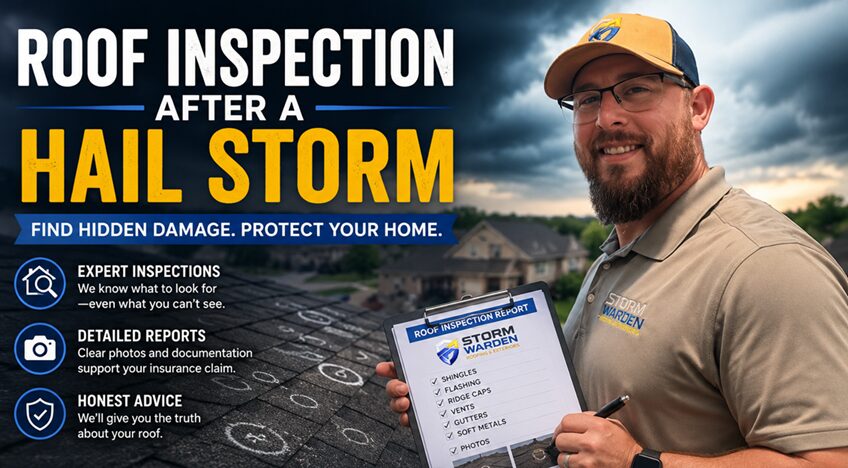
A Storm Warden inspection can document multiple things such as:
- Storm dates in the area
- Hail impacts
- Damage to gutters and downspouts
- Dented vents and other soft metals
- Wind-lifted shingles or missing shingles
- Damaged windows and window screens
- Damaged Fence line
- Other storm related conditions
If we don’t find legitimate storm damage, we’ll tell you and recommend next steps.
If we do find damage, we’ll document and photograph what we see. We will then explain your options so you can make an informed decision about what happens next.
What Happens if the Insurance Estimate Misses Something?
Getting a claim approved isn’t necessarily the end of the process.
Insurance estimates sometimes leave out roofing components, code related items or other work required to complete the project properly. When appropriate, additional documentation can be submitted by us to your insurance carrier through the supplemental claims process.
Storm Warden has a dedicated supplemental claims team to help address legitimate scope discrepancies and properly document supplemental items. Their guide to the anatomy of an insurance claim is a useful resource for homeowners who want to better understand what’s the Replacement Cost Value (RCV) and Actual Cost Value (ACV) mean, what depreciation is and the general claims process.
Don’t Wait Until the Next Storm to Find Out What the Last One Did
If your home went through one of this year’s North Texas hail or wind storms and nobody ever inspected the roof, this calmer part of the year is a great time to have it checked.
You may find out everything is fine, and your roof is ready to handle the storm season for next year. But if damage is there, finding and documenting it now is better than discovering it after a leak, or after your insurance policy claim deadline has passed.
At Storm Warden, our job isn’t to convince you that you need a new roof. Our job is to tell you the truth about the one you have.
Schedule Your Roof Inspection
If your home experienced hail or damaging winds earlier this year, schedule an inspection now to ensure your home is ready for next year’s storm season.
When the storms strike… Call the Warden.
📞 682-224-2097
🌐 SWRAE.com